THINGS WORTH TRACKING / 001

A little further
from home.

Some things are too extraordinary to lose sight of.

Start with the International Space Station.
Follow its latest available position above Earth.

Find the space station

THINGS WORTH TRACKING

International Space Station

Locating the station
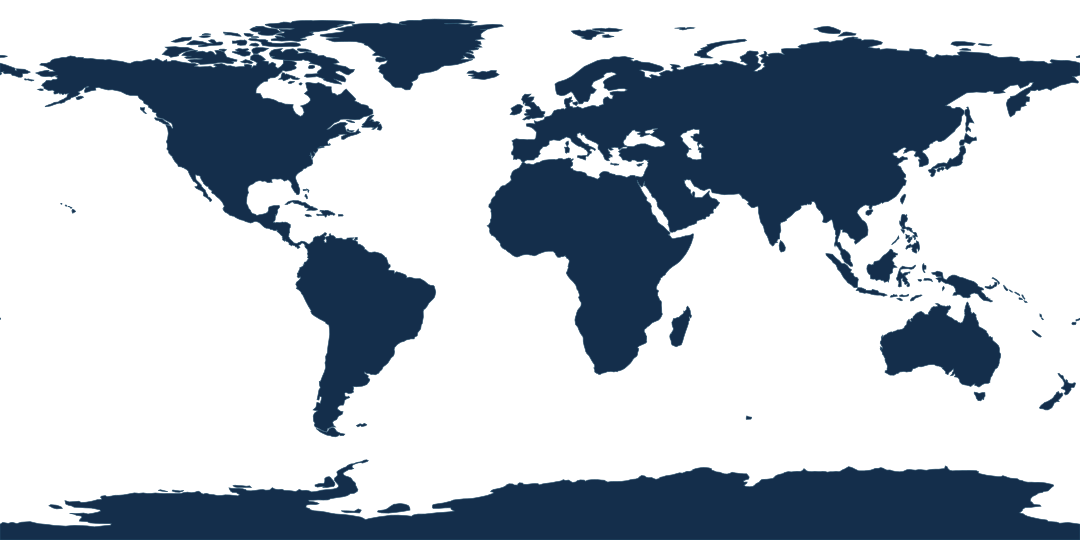
EARTH / GROUND POSITIONISS · 25544
Position appears when availableMade with Natural Earth ↗
POSITION SOURCE Where the ISS at? ↗Calculated orbital estimate, not direct onboard telemetry.
About the data

This map plots the latest position returned by Where the ISS at? for the International Space Station (NORAD 25544). The provider calculates orbital positions. “Position time” is the time attached to that calculation, not a confirmed onboard sensor observation.

Updates older than 60 seconds are marked stale. If an update fails, the last usable position stays visible with a delayed notice. After five minutes, the point and numbers are hidden. Altitude and speed appear only when supplied in the expected units. No positions are predicted or animated by this page.

002 / BACK ON EARTH

Different orbit.
Same need to know.

A space station above the ocean. A vehicle on the road. A trailer at the depot. Knowing where something is starts with a position you can trust.

That is the thinking behind TG Tracking: making the things that matter easier to keep in sight, here on Earth.

A POINT IS ONLY PART OF THE STORY.

Where is it?
When was it there?
Can I trust the update?

GOOD TRACKING ANSWERS ALL THREE.

003 / THE FLEET BEYOND THE VEHICLES

Back on Earth,
things get interesting.

Your fleet is more than the vehicles. It is what they carry, what they tow, what they deliver and what they leave behind. Some of the most useful things to track are the ones you would never expect.

Real-world application examples. These are not live trackers or TG customer installations. The right configuration depends on the asset, coverage and sensors.

A jet engine secured on a wheeled transport stand outside an aircraft hangar.

Jet engine transport stands

Not every jet engine travels by air.

An engine can spend part of its journey on wheels. Keeping sight of its transport stand helps teams find it between storage, maintenance and delivery. Monitoring knocks, temperature or humidity takes additional sensors.

Three blue-grey portable sanitation units at a construction site.

Portable toilets

Even this needs a location.

Deliver it. Service it. Bring it home. A portable toilet can move through several sites before returning to the yard. Its location helps organise the next visit; checking how full it is requires a separate sensor.

A concrete mixer truck with its rear discharge chute extended at a construction site.

Concrete mixer drums

Track the pour. Not just the truck.

Arriving on site is one moment. Unloading is another. Paired with a compatible drum-rotation sensor, location data can help show where and when concrete was discharged. Position alone cannot identify the pour.

A detached steel excavator bucket with five digging teeth resting in an equipment yard.

Excavator buckets & attachments

The excavator left. Where’s the bucket?

The machine moves to the next job, but an attachment can stay behind. A battery-powered tracker fitted to the bucket helps teams locate it independently, whether it is waiting in a yard or still on site.

Three linked airport baggage dollies, one carrying luggage secured under a net.

Airport baggage dollies

A fleet without engines.

No engine. Plenty of journeys. Airport dollies carry baggage and cargo, then wait for their next assignment. Independent location tracking helps crews find them. Detecting whether a dolly is loaded needs an additional capability.

A roll-off waste container left at an industrial site as its transport truck drives away.

Roll-off skips & waste containers

The truck came back. The bin didn’t.

A skip can stay with a customer long after the truck returns. Tracking the container independently helps teams see where it is and how long it has been there, making collections and idle capacity easier to plan.

START WITH WHAT MATTERS TO YOU

What does your fleet
leave behind?

Tell us what you need to find, protect or understand.